
Welcome to the November edition of The Monitor.
December 6 marks an important milestone in the shift toward 23/5 trading with expanded overnight trade reporting and market data operations set to begin. As we approach this next phase, I’m particularly interested in how firms are preparing to manage the operational demands of longer trading hours.
For firms, the challenge is scaling their technology, operations, and oversight without a proportional increase in costs and resources. That requires infrastructure that can adapt to changing market conditions while keeping operations efficient and oversight effective.
In this month’s Monitor, we’re looking at what 23/5 means for market oversight, the technology considerations firms should be evaluating, and recent developments in perpetual futures and other evolving markets.
Wishing everyone a wonderful Thanksgiving!
— Lisa Balter Saacks, President, Trillium Surveyor
Surveyor Product Perspective
Perpetual Futures: Understanding the Activity Behind the Price
The introduction of single-stock perpetual futures on Kalshi adds another dimension to market surveillance. As these products expand, firms need to evaluate trading activity in the context of liquidity, order behavior, and related markets.
A recent example involving an NVIDIA perpetual futures contract showed a temporary price movement of roughly 15%, raising an important question: what actually happened in the market?
A sharp price movement alone doesn’t tell the full story. To determine whether it warrants further investigation, firms need to understand the current market conditions and how participants were trading at the time.
How Surveyor supports this analysis:
- Behavioral Analysis: Evaluates activity against an account’s historical trading profile to identify deviations from established patterns.
- Built-In Market Context: Provides liquidity, volume, and historical market information to help investigators understand the conditions surrounding unusual activity.
- Cross-Product Coverage: Supports surveillance across equities, futures, event contracts, and other asset classes, providing broader visibility into trading activity.
- Context-Rich Alerts: Combines relevant market context, supporting evidence, and natural-language summaries to help investigators understand why activity was flagged and determine whether further investigation is warranted.
As new trading products emerge, effective surveillance depends on understanding the activity behind a price movement, not simply identifying that a price moved.
Regulatory Radar
- SEC Adjusts Reference Pricing for Overnight Trading
The SEC has temporarily put into effect an amendment to the Limit Up-Limit Down Plan, shifting the Consolidated Price reference time from 7:45 p.m. to 7:30 p.m. ET. The adjustment is designed to support overnight price band protections as markets prepare for expanded trading hours. For surveillance teams, the change reinforces the importance of evaluating trading activity in the context of session-specific reference prices and market conditions. (Source: SEC)
- CFTC Announces Expansion of Single-Stock Perpetual Futures
On November 3, the CFTC announced that single-stock perpetual futures can begin trading on appropriately registered U.S. exchanges. The development marks an expansion of perpetual futures into traditional equities, introducing new considerations for monitoring trading activity and maintaining effective oversight across related markets. (Source: CFTC)
- FINRA Preserves Circuit Breaker Cooling-Off Period Ahead of 23/5 Trading
FINRA amended Rule 6121.02 to ensure that trading does not resume before 4:00 a.m. ET the following trading day after a Level 3 market-wide circuit breaker halt to preserve the existing cooling-off period as the industry moves toward 23-hour trading. The rule change takes effect December 6. For surveillance teams, this means accounting for market-wide trading halts that extend into what would otherwise be an active overnight session. (Source: FINRA)
- SEC Enforcement Results Signal a More Targeted, Data-Driven Approach
On November 10, the SEC reported 348 enforcement actions in fiscal year 2026, including 235 standalone actions, and $1.095 billion in monetary relief. While overall enforcement numbers fell, the SEC continued to pursue market manipulation and insider trading, including spoofing and deceptive trading. Through its new Office of Super Intelligence and Analytics, the SEC is leveraging AI and advanced analytics to identify potential misconduct earlier and improve investigative efficiency. These developments reinforce the importance of effective, data-driven trade surveillance. (Source: SEC)
- CFTC Finalizes Data Reporting Rules for Event Contracts
On November 23, the CFTC approved a final rule establishing a formal reporting framework for certain fully collateralized event contracts, replacing previous reliance on staff no-action letters. The rule includes requirements for trader identification and settlement data, reinforcing the importance of data quality and transparency as prediction markets continue to grow. (Source: CFTC)
Market Structure and Compliance Trends
23/5 Trading: What Changes for Market Oversight?
As U.S. equities markets prepare for longer trading hours, firms need to consider how their surveillance and operational processes will adapt. Overnight trading is already available through alternative trading systems, while exchanges and market infrastructure providers are preparing for broader extended-hours activity.
Understanding the Changing Trading Day
Our latest chart compares today’s U.S. exchange trading hours, existing overnight ATS sessions, and Nasdaq’s planned 23/5 schedule.
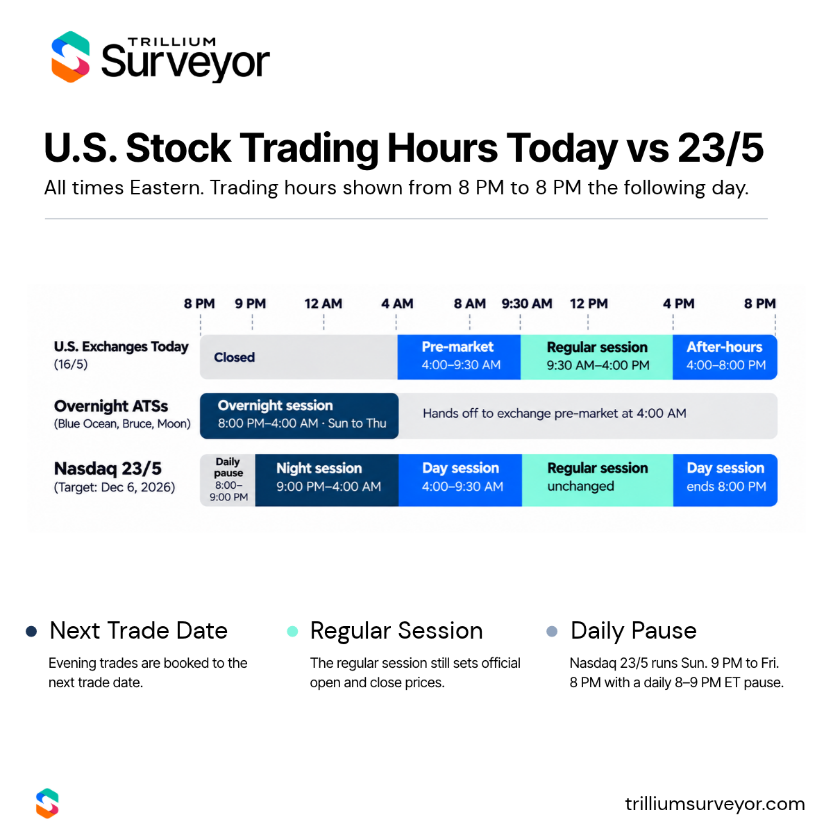
The implications for firms extend beyond the additional hours:
- Different trading conditions: Trading at 3 a.m. is fundamentally different from trading at 3 p.m. A trade with little market impact during regular hours could represent a significant share of available liquidity overnight. Effective surveillance requires session-specific parameters supported by historical trading data and market context.
- Reference pricing: As trading sessions expand, firms need to distinguish between traditional closing prices and reference prices used during extended trading. Surveillance must consider whether trading activity actually influenced a reference price, rather than simply flagging trades near a particular time.
- Operational complexity: Longer trading hours introduce new considerations around trade dates, activity across sessions, and investigation workflows. Firms need to scale their operations and oversight without a proportional increase in staffing and costs.
- Technology infrastructure: As trading hours expand and new venues emerge, firms need flexible infrastructure that can integrate and normalize market data across multiple sources, adapt to changing market conditions, and reduce the burden of ongoing technology updates.
The takeaway: Preparing for 23/5 requires more than extending existing processes into additional hours. It requires an established understanding of overnight trading behavior, surveillance that adapts to each session, and technology that enables firms to scale oversight efficiently as markets evolve.
Want to learn more? Rob Cope answers key questions about the shift to 23/5 trading and what firms should consider as markets evolve. Read the 23/5 Q&A here→
Poll
As trading hours expand, what’s the biggest challenge for your firm?
- Technology and infrastructure
- Effective trade surveillance
- Staffing and operational costs
- Market data quality and access
Participate in the community poll here.
Our Social Calendar
Where to Find Us Next
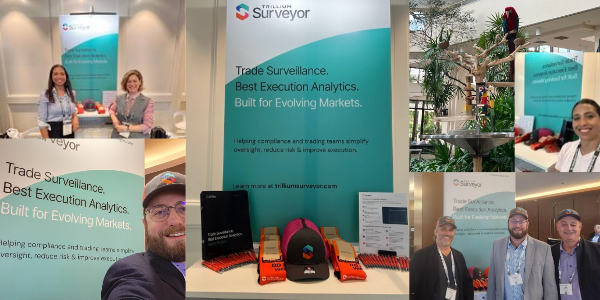
It’s been a busy fall for the Surveyor team! We enjoyed connecting with everyone at the NSCP National Conference in Orlando and the FINRA Small Firm Conference in Chicago, where our new Director of Sales, Erik Schwartz, had the opportunity to meet many of you. Charlie Roberts also attended FIA Expo in Chicago, and we rounded out our fall conference season at STA Charleston.
Didn’t get a chance to connect with Erik? He’d love to meet you!
Schedule a Conversation with Erik →
Looking ahead to 2027, we’re excited to continue our Surveyor Executive Roundtable Series, bringing industry leaders together for focused discussions on emerging market developments and challenges. Stay tuned for upcoming events and invitations!
Let’s Connect!
As we wrap up 2026 and look ahead to 2027, we’d love to hear what your team is prioritizing for the year ahead. Whether you’re preparing for evolving market structure, evaluating your surveillance and best-execution analytics needs, or simply looking to exchange perspectives, we’d welcome the conversation.